So Many Gauge Choices
One of the best things about restoring or building any vehicle is the choices you get to make. Some are significant, and others not so much. Every once in a while, you have to make decisions that can literally affect the stability and longevity of the vehicle.
Gauges are a critical component—consider them to be the window to the inner workings of your ride. The hard part is picking the right ones. You have to consider brand, size, color, electric vs. mechanical, and digital vs. analog. While you have the common fuel and speedo units, a turbo car needs to monitor boost, vacuum, and the most critical metric: Air/Fuel Ratio (AFR).
Turbo Camaro is undergoing a transformation to a turbocharged street demon. It’s carbureted, using a Holley 4776 600cfm double pumper, meaning no fancy computers to tune everything automatically.
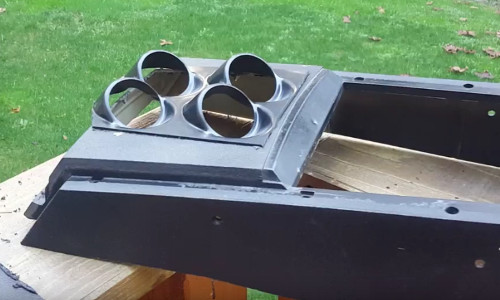
Custom 4 gauge console pod for Turbo Camaro’s gauges.
Tuning a carburetor for a naturally aspirated engine is tricky; adding a turbo exponentially increases the difficulty. You need real-time AFR. Most modern cars use a narrowband sensor (basic rich/lean info), but for tuning, you need a Wideband. A wideband provides the exact ratio on a scale, which is a necessity for tuning a turbo car yourself.
The Vacuum/Boost and AFR gauges are for tuning, but you also need to monitor health. Sudden oil pressure drops or charging system failures can be caught before they result in a catastrophic engine failure or a car that won’t start.
Turbo Camaro will keep its stock odometer, speedometer, and fuel gauge. However, with the custom four-gauge console pod, we are installing a 52mm AEM Wideband AFR, VDO Oil Pressure, VDO Vacuum/Boost, and a VDO Voltmeter.
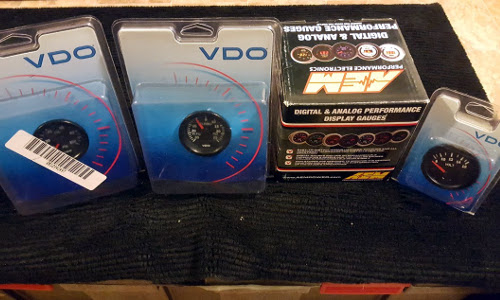
Turbo Camaro’s gauge selection - Oil Pressure, Vac/Boost, AFR and Voltmeter.
Why this specific set? Oil pressure is vital because you can feel a drop and immediately confirm it. Volts matter because if the car won’t start for the next ride, the performance parts are useless. An EGT gauge would be nice, but with the AFR in check, monitoring exhaust temp is a secondary benefit.
Cheap gauges can be enticing, but an inaccurate reading is worse than no reading at all. VDO is a great “bang for your buck” brand, and the AEM Wideband was the closest visual match to keep the set looking uniform.